Consultancy · Los Angeles & New York

Supply chain analytics built for your operation.

We advise distribution and fulfillment leaders on three decisions that lock in cost for a decade: the facility, the slot, and the network. Evidence first. Capital second.

The firm

We model the warehouse as a designed system, then draw the layout from that model.

Most storage studies arrive late, stay opaque, and expire the week demand shifts. We sit with operations leadership, take the extracts you already have, and return a model you can defend in a capital meeting: what to build, what to slot, and where product should live in the network.

Practice

Three engagements. One operating picture.

Isometric technical drawing of a distribution center floor plate 01

Facility modeling

Baseline the building you have, or the one you are about to fund. Clear height, bay types, dock capacity, pick modules, and automation envelopes, tested against your own inventory and velocity.

  • Current-state facility model from WMS extracts
  • Greenfield and retrofit scenarios
  • Automation bid support with a defensible baseline
Overhead view of warehouse aisles with pick velocity concentrated along the cross-aisle 02

Slotting strategy

Assign every SKU a home that pickers can run. Pickface versus reserve, unit-of-measure fit, and velocity classes, modeled to your labor and equipment rather than a generic ABC sort.

  • Pickface days-on-hand and utilization caps
  • Manual and automated pick-path designs
  • SKU-level workbook, not a slide of averages
Minimal cartographic network of distribution nodes and routes 03

Network design

Decide how many buildings, where inventory sits, and how flow should move when volume steps up. We connect node strategy back to the facility and the slot so the network does not orphan the floor.

  • Node count, role, and inventory posture
  • Growth, seasonality, and service-level cases
  • Implications for each building’s storage mix

Evidence

Output from the engine, not a rendering of it.

Fig. 01

31% of SKUs carry 80% of unit volume.

Concentration decides where pickface investment goes. When a third of the catalog moves four fifths of the units, resizing every location is waste. The A band is the only place worth spending on.

Pareto curve of cumulative unit volume against cumulative share of SKUs, with the 80% line crossed at 31% of SKUs and A, B, and C item bands shaded
Storage Strategy Engine · SKU Pareto · baseline model Open full size
Fig. 02

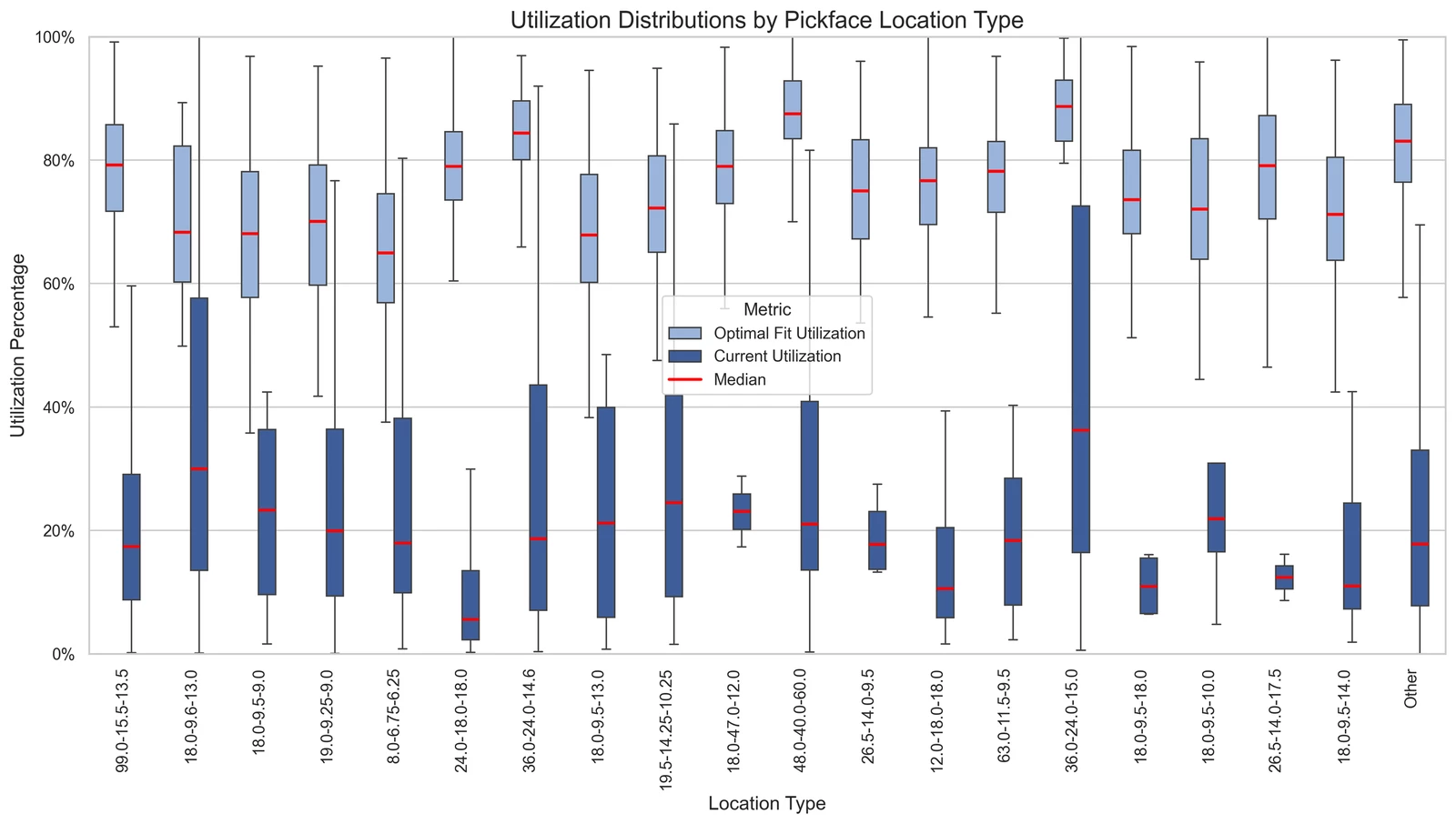
Pickfaces run near 18% full where the fit allows 83%.

Each location type is shown twice: what the current slotting achieves, and what an optimal fit would. The gap between the pairs is recoverable space, found without buying a single new rack.

Paired box plots comparing current and optimal-fit utilization for each pickface location type, showing current medians far below optimal
Storage Strategy Engine · utilization by pickface location type · baseline model Open full size

Figures are live output from a baseline run, reproduced as the engine draws them. A full engagement returns twenty-plus of these with written commentary and the SKU-level workbook behind them.

Method

A short engagement. A complete model.

We do not open an IT program. You pull three extracts. We validate, parameterize, and return a baseline plus the futures you actually need to compare.

  1. 01
    Brief

    Scope the decision: new building, slotting reset, automation bid, or network change.

  2. 02
    Import & validate

    SKU master, location-level inventory, and velocity, as order lines or summarized.

  3. 03
    Model the futures

    Inventory, velocity, location libraries, and fitting logic set to your constraints.

  4. 04
    Decide with evidence

    Plots, written findings, and a SKU-level Excel file you can take into operations.

Still life of a floor plan, brass calipers, and an architect scale
Industrial engineering, practiced as a studio.

Engagement shape

  • 3 Core practices in every operating picture
  • 20+ Analytical plots in a typical engine report
  • 3 Extracts. No IT project required.

Bring us the decision in front of you.

Three extracts and a short briefing are enough to start.

Request a briefing